Can AI make a real commercial? What brands are learning
Yes. AI can already make parts of a real commercial, and sometimes all of it. But the brands getting good results treat AI as a production tool, not a way around production. Here is what the first big AI campaigns taught the industry , and what we see in our own work.
What has already aired
Coca-Cola, 2024. Coca-Cola remade its 1995 classic “Holidays Are Coming” with AI video tools. Three studios, Secret Level, Silverside AI and Wild Card, each made their own version using Leonardo, Luma and Runway. Online, many people said it looked fake. Yet when the research firm System1 tested it with viewers, it scored 5.9 stars and very strong positive emotion. Coca-Cola’s head of generative AI said the creative decisions were still made by people. (Fast Company)
Toys“R”Us, 2024. The brand premiered an origin-story film at Cannes Lions, made with the studio Native Foreign using OpenAI’s Sora. Even this “AI film” was, in the brand’s own words, “almost entirely created with Sora, with some corrective VFX and an original music score” by a human composer. (WHP Global)
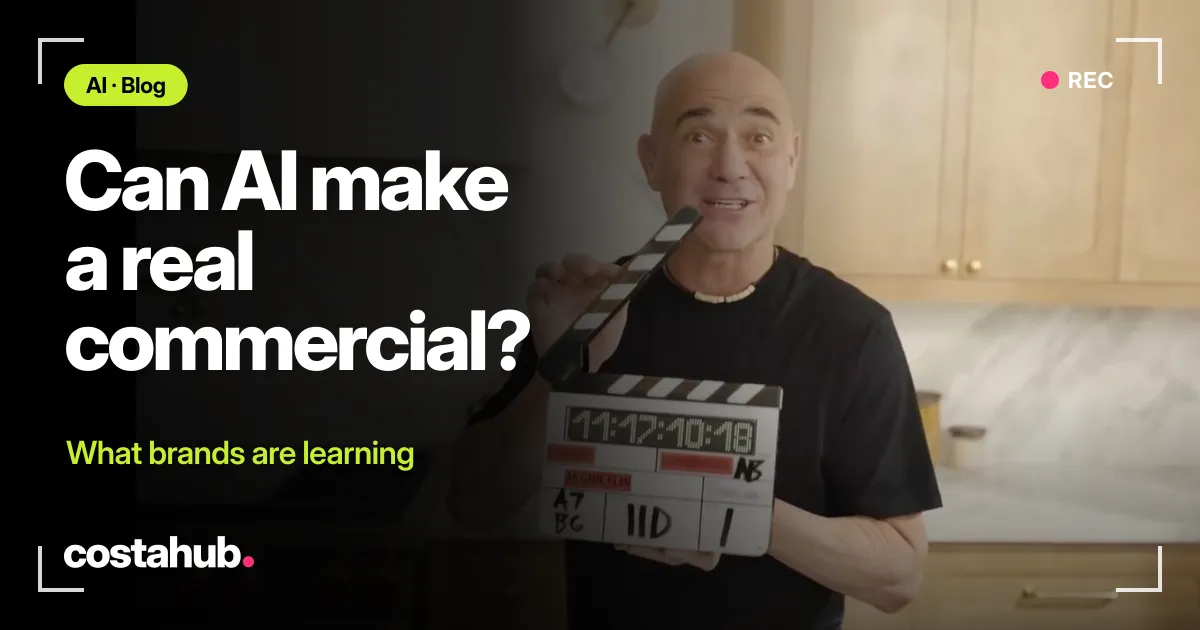
Our own work. For Lidl’s SILVERCREST relaunch with Andre Agassi, we mixed AI-generated shots into a live-action campaign: a reverse blend, a pizza oven and coffee pours. They sat inside more than 180 finished videos in 8 languages. Our black-and-white AI film also won a Higgsfield competition.
Five things brands are learning
AI shines where cameras struggle. Products that transform, impossible camera moves, surreal worlds, a pizza oven that appears from nowhere. These shots used to mean days of VFX. People talking straight to camera are still where viewers spot AI fastest.
Mixing beats replacing. The strongest results keep real talent and the real product on camera. AI fills the inserts, transitions and shots that would blow the budget. Viewers judge the whole spot, not the tool.
Consistency is the hard part. Getting one great AI shot is easy. Getting the same product, logo, light and character across fifteen shots is the real work. It takes compositing, cleanup, colour grading and an editor who knows when to cut away.
Legal checks don’t disappear. The product must look exactly like the one in the shop. Every tool needs a licence that allows commercial use. Any real person needs their consent. From August 2026, the EU AI Act also requires realistic AI-generated video of people, places or events to be disclosed as such. Ask your lawyer how this applies to your campaign.
The audience reacts to the idea, not the tool. The backlash Coca-Cola faced was about a much-loved classic being remade, not about AI as such. AI used for spectacle or humour gets far less pushback than AI that imitates something people are attached to.
What AI actually saves
AI saves the most time before and after the shoot. Storyboards and animatics that took a week now take a day or two, so clients see the film before money is spent. Versions for markets, formats and lengths are faster too. It saves the least on the brief, the idea, the approvals, the edit and the sound. That is still where a commercial is won or lost.
So, can it make a real commercial?
It can, when it is treated like any other production. That means a script, a director with taste, a clear look, a proper edit, sound design, a colour grade and legal checks. We decide shot by shot whether to film it, generate it or combine the two. Most of the time, the answer is a mix.
Where to start
- A 5–15 second social spot or bumper. It is low risk and fast, and you learn how your audience reacts.
- AI previz before a big shoot. See the whole film before you book a crew.
- AI shots inside an existing campaign. One impossible shot can lift a spot that is otherwise filmed for real.
Thinking about AI for your next campaign? [Book a meeting] and we’ll show you what we’d film and what we’d generate.


